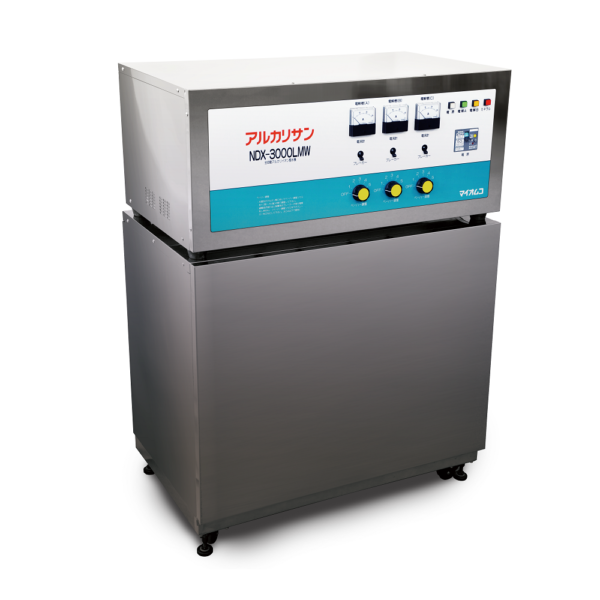
NDX-3000LMW industrial alkaline water ionizer equipment provides high-volume alkaline and acidic ionised water production for suitable industrial applications. The system is designed for continuous operation with flip-flop electrolysis technology that helps limit calcium build-up on the electrodes.
Industrial water production capacity
The NDX-3000LMW can produce up to 3,000 litres of alkaline ionised water per hour and up to 1,500 litres of acidic water per hour. It is designed for continuous operation of up to 23 hours, representing up to 69,000 litres of water in one operating cycle.
Flip-flop electrolysis
The system alternates electrode polarity during operation. This process helps reduce calcium accumulation and lowers the need for routine chemical cleaning.
Electrode construction
Platinum-coated titanium electrodes are used for the electrolysis process. Their construction supports continuous industrial operation.
Adjustable pH output
Five-stage pH adjustment allows the system to produce alkaline water from pH 7.0 to 10.0 and acidic water from pH 4.0 to 7.0. The required water quality and intended application must be confirmed before the system is selected.
Key specifications
- Up to 3,000 litres per hour alkaline water output
- Up to 1,500 litres per hour acidic water output
- Five-stage pH adjustment
- Alkaline range from pH 7.0 to 10.0
- Acidic range from pH 4.0 to 7.0
- Platinum-coated titanium electrodes
- Up to 23 hours of continuous operation
Feed-water quality, required pH, operating volume and the intended use must be assessed before installation. Contact Seagle Coding with the water analysis and production requirement so that the system can be reviewed correctly.
Download the NDX-3000LMW product overview.
Plan the water-treatment installation
Specify the required alkaline and acidic output separately, together with the target pH and operating hours. Supply a recent feed-water analysis and explain the intended industrial process. Seagle can review the application and installation requirements before a final configuration is proposed.
Which water information is needed?
Provide the source, available supply volume and water-analysis results. These help assess suitability for the intended process.
How should I specify the required output?
State the hourly demand, target pH for each stream and planned operating cycle rather than relying only on the maximum stated capacity.
Compare equipment and get application advice
Explore our water treatment systems.
For installation and ongoing assistance, view our equipment services. Discuss this application with Seagle Coding.