Comparing inkjet coding vs laser marking starts with your substrate and production requirements. Industrial inkjet printers and laser marking systems can both apply dates, batch numbers, traceability information, barcodes and other variable data during production. Both technologies are non-contact, but they create the code in different ways and have different installation, operating and maintenance requirements.
The right choice depends on the product or packaging material, the required code, line speed, production environment, available installation space and the expected life of the mark. A sample test on the actual substrate is one of the most reliable ways to confirm the result before equipment is specified.
See practical applications in our PVC pipe marking case study and HDPE milk-bottle date coding case study.
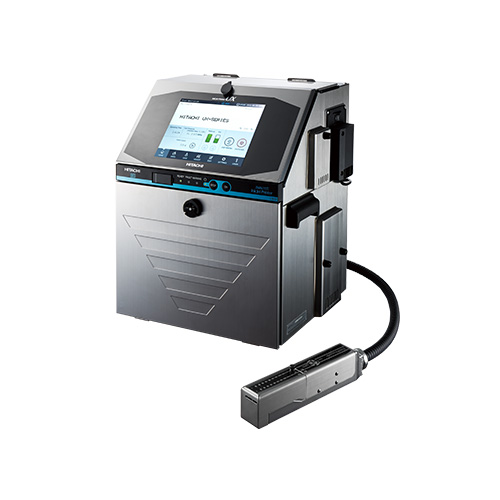
CIJ
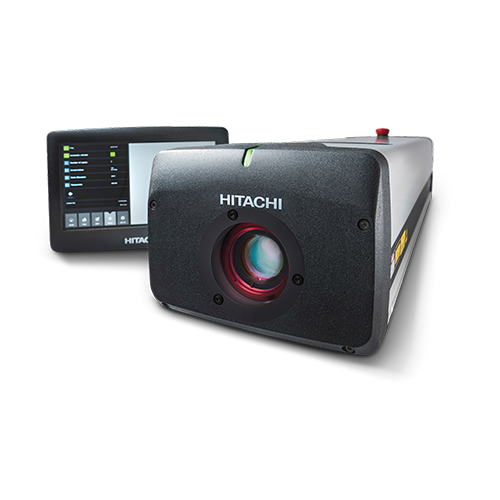
LASER
Quick comparison
| Consideration | Continuous inkjet coding | Laser marking |
|---|---|---|
| How the code is created | Ink droplets are directed onto the surface | A focused laser beam changes or removes part of the surface or coating |
| Code permanence | Depends on the ink, substrate and operating environment | Usually permanent when the material and laser are correctly matched |
| Suitable surfaces | Broad substrate range, including curved and irregular products | Depends strongly on material response and laser type |
| Consumables | Ink, solvent or make-up fluid and routine service items | No coding ink, but extraction filters and maintenance may be required |
| Initial investment | Usually lower | Usually higher |
| Installation | Compact printhead with flexible positioning | Requires suitable guarding, extraction and a controlled marking area |
| Typical appearance | Clear dot-matrix or line code with ink-dependent contrast | High-resolution mark created in or on the material |
What is continuous inkjet coding?
Continuous inkjet, commonly called CIJ, directs small ink droplets from a printhead onto a moving product without touching it. The technology is widely used for production-line coding because the compact printhead can be positioned beside, above or below the product path.
With the correct ink and setup, CIJ can code a wide range of materials and product shapes. Typical applications include bottles, cans, cables, pipes, cartons, components and flexible packaging.
When inkjet coding is often a strong option
- The product is curved, uneven or difficult to reach.
- Different ink colours or specialist ink properties are required.
- The production line has limited space around the coding position.
- Equipment may need to be moved between lines or applications.
- The business wants a lower initial equipment investment.
- The code is a date, batch number, lot number or other variable production information.
Inkjet operating considerations
Inkjet printers use consumable fluids and require routine cleaning and maintenance. Code performance depends on the selected ink, substrate condition, print distance, product stability and production environment. Condensation, dust, oil, temperature and cleaning processes should be considered during the application assessment.
What is laser marking?
A laser marking system uses focused light to change the surface, coating or pigment of a material. Depending on the substrate and laser type, the process may create contrast by engraving, ablation, colour change or another controlled material reaction.
Laser marking does not use coding ink. When the correct laser and parameters are matched to the material, it can produce a permanent, high-resolution mark suitable for traceability and long-term identification.
When laser marking is often a strong option
- The code must be permanent or difficult to remove.
- High-resolution text, logos, barcodes or Data Matrix codes are required.
- The application has high production volumes and stable product handling.
- The material responds well to the selected laser wavelength.
- The operation wants to reduce its dependence on coding inks and solvents.
- The line can accommodate the required guarding and extraction system.
Laser installation considerations
The material must be tested because different plastics, coatings, metals, glass products and packaging films respond differently to laser energy. The installation must also consider guarding, fume extraction, focal distance, marking field, product movement and line control.
The substrate is the starting point
The same technology will not produce the same result on every material. A code that works well on glass may require a different ink or laser configuration on PET, HDPE, coated board, metal or flexible film.
Before selecting equipment, confirm:
- The exact substrate and colour
- Whether the surface is dry, wet, dusty, oily or exposed to condensation
- Whether the product is flat, curved or irregular
- Whether the mark must withstand rubbing, chemicals, heat, refrigeration or outdoor exposure
- Whether packaging materials or suppliers may change
Code durability and appearance
Laser is normally considered when permanence and high-resolution appearance are priorities. CIJ provides greater flexibility through different inks and can create strong contrast on a broad range of products.
Neither option should be selected from a brochure alone. A real sample test helps confirm contrast, adhesion, readability and any effect on the material.
Production speed and product handling
Both CIJ and laser systems can operate on fast production lines, but line speed is only one part of the application. Product spacing, movement, vibration and the time available to create the mark are equally important.
A stable conveyor and reliable product detection help both technologies place the code consistently. Laser marking may require a defined marking field and sufficient dwell time. CIJ must maintain the correct print distance and product path past the printhead.
Installation space and line integration
CIJ printheads are compact and connected to the printer cabinet by an umbilical, which can make them easier to position in confined areas. Laser systems require a marking head, a controlled beam path, guarding and extraction. These requirements should be assessed before the machine is ordered.
The coding system may also need signals from a sensor, encoder, programmable logic controller or production database. This should be confirmed during the line assessment.
Initial cost and ongoing operating cost
CIJ normally has a lower initial equipment cost, but it uses ink and solvent or make-up fluid throughout its operating life. Routine cleaning, filters and planned maintenance also form part of the operating cost.
Laser normally requires a higher initial investment, together with suitable guarding and extraction. It does not consume coding ink, although extraction filters and planned maintenance still need to be considered.
A useful cost comparison should consider expected production hours, consumable use, maintenance, installation, code quality requirements and the expected service life of the equipment.
Questions to answer before choosing
- What product, container or substrate must be coded?
- What information must the code contain?
- How permanent must the code be?
- What is the production speed and product spacing?
- What environmental conditions exist at the coding point?
- How much installation space is available?
- Will the system need to communicate with other production equipment?
- What are the expected operating hours and changeover requirements?
Is inkjet or laser better?
Neither technology is automatically better. CIJ is often selected for flexible installation, broad substrate compatibility and variable production requirements. Laser is often selected for permanent, high-resolution and ink-free marking where the material and installation suit the process.
The best result comes from matching the technology to the real production application.
Frequently asked questions
Can both systems print batch numbers and expiry dates?
Yes. Both technologies can apply variable production information. The required content, print size, line control and data source must be confirmed during specification.
Can inkjet and laser code curved bottles?
CIJ is well suited to many curved and irregular products because it prints without contact and can operate at a controlled distance from the surface. Laser can also mark curved products, but the marking field, focal distance and product movement must be assessed carefully.
Does laser marking need consumables?
Laser marking does not use coding ink. The complete installation may still require extraction filters and planned maintenance.
Is a laser code always permanent?
Laser marks are generally selected for permanence, but the result depends on the material, laser type and marking parameters. Sample testing is essential.
Which option is cheaper?
CIJ usually has a lower initial purchase cost. Laser usually has a higher initial investment but does not use coding ink. The correct comparison depends on production hours, consumable use, maintenance and installation requirements.
Arrange an application assessment
Seagle Coding supplies, installs and supports industrial inkjet and laser coding systems across South Africa and selected African markets.
To assess an application, provide the product or packaging material, required code, production speed, available installation space and photographs or video of the production line. Where possible, provide samples for print or marking tests.